
The most popular 3rd party classes and subclasses, outlined and evaluated by us.
D&D has a ton of options for your character. Sometimes though, you want to try something different. Maybe that’s a subclass that better fits the vibe of your character or you’re tired of the same 13 classes and want to switch up your playstyle. Whatever the reason, there’s loads of 3rd party character options out there for you to give a whirl.
From Matt Mercer’s hemalurgic blood hunter to MCDM’s anti-paladin, the hellish illrigger, there’s lots of options to try. The problem is knowing which are worth your time and which are duds. That’s a big part of the reason why we perform detailed analyses of the classes and subclasses in 3rd party sources, so you can know before you buy whether the monster hunter or bender you want to try is worth your money.
Below I’ve compiled all the 3rd party classes and subclasses we’ve analysed for D&D 5e (plus a few more we intend to get round to). I’ve summarised each one so you know what they’re about and linked through to our deep dives to help you find great 3rd party content for your campaign. I’ll keep updating this as we cover more class options and new 3rd party resources are released.
3rd party D&D 5e classes

Blood hunter
Creator: Critical Role
Publication: The Blood Hunter Class
Edition: 5e 2014
Where to buy: D&D Beyond
Warriors that dabble in oft-maligned blood magic
About blood hunters
Blood hunters are perhaps most similar to witchers. Both are hunters of monsters and both undergo mutations to enhance their natural capabilities while being largely shunned by society.
Where blood hunters differ is in their use of blood magic. This offers them unique capabilities, in part, transforming them towards the very evils they intend to eradicate.
Strengths
- Capable martial warriors
- Disruptors that merge weapon attacks with curses
- Able to enhance attacks with hemalurgical powers
Weaknesses
- Their best abilities will also harm themselves
- Not as resilient as some other martial classes like barbarians and paladins
- Complicated mechanics make them a challenging class to play
Blood hunter subclasses
- Order of the ghostslayer – Blood hunters dedicated to eradicating the curse of undeath.
- Order of the lycan – Willing recipients of lycanthropy who seek to master its bloodlust to enhance their own capabilities.
- Order of the mutant – Use alchemy to mutate their bodies, allowing them to adapt to the foes they face.
- Order of the profane soul – Make pacts with powerful entities to gain the powers possessed by warlocks.
Related articles
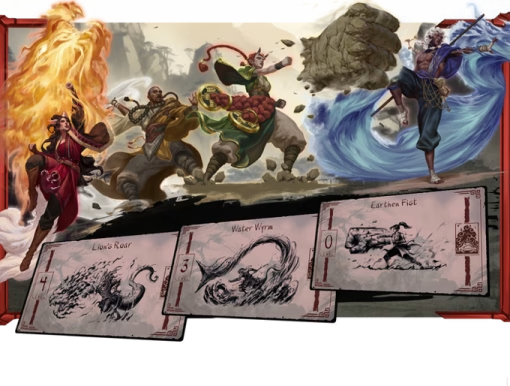
Bender
Creator: Loot Tavern Press
Publication: Ryoko’s Guide to the Yokai Realms
Edition: 5e 2014
Where to buy: Loot Tavern Press
Magic-weaving monks reminiscent of airbenders
About benders
Benders are the D&D equivalent of airbenders from Avatar The Last Airbender, possessing a bit less martial prowess than a monk possesses. However, this is compensated for with a strong helping of elemental magic.
Strengths
- There’s loads of flexibility like optional spellcasting abilities, elemental paths and unique subclass roles.
- Unique subclasses allow you to fulfill multiple different party roles depending on the needs of the group.
- Spellcasting gives them utility outside of combat and versatility within combat.
Weaknesses
- As a half-caster, you have fewer spell slots than a Wizard or Sorcerer, which can make them feel restricted in longer adventuring days.
- Managing affinities, elemental combos, subclass features, and transformation states can be overwhelming and complex for newer players.
Bender Subclasses
- Ferocity discipline – Aggressive warriors that focus on dealing as much damage as possible.
- Fortification discipline – A highly defensive subclass that specialises in protecting others.
- Fusion discipline – Elemental specialists that focus on combining elements and controlling the battlefield.
- Invigoration discipline – Make decent healers and buffers.

Illrigger
Creator: MCDM Productions
Publication: The Illrigger Revised
Edition: 5e 2014
Where to buy: D&D Beyond
Knights of Hell fulfilling the role of an anti-paladin
About illriggers
The knights of Hell, illriggers are the agents of Archdevils, assigned to specialised operations that require a cunning mind and a capable sword (and usually some other skill sets too). They specialise in applying debuffs and extra damage through magical effects on their enemies, though most are not spellcasters themselves.
The closest approximation to an illrigger is the paladin, but as primarily evil individuals, illriggers are sort of the antithesis of the paladin. An unholy herald of the powers of Hell.
Strengths
- Powerful martial warriors
- Enhance attacks with magical seals
- Particularly resilient against saving throws
Weaknesses
- Lack the nova damage and spellcasting of paladins
- Can be quite fiddly to play with lots of things to track
- Need to pick abilities that interact well with your build
Illrigger Subclasses
- Architect of ruin – Spellblades that weave magic to deceive their foes.
- Hellspeaker – Highly charismatic illriggers that weave enchantments to manipulate and coerce.
- Painkiller – Strategists and the generals of the Hellish armies, they’re equally adept at duelling one on one as they are at managing armies.
- Sanguine knight – Drink of their enemy’s blood to imbue themselves with forbidden blood magic.
- Shadowmaster – The assassins of Hell, shadowmasters maintain networks of spies, gathering information and eliminating targets for their devilish masters.

Lingering soul
Creator: Critical Role
Publication: The Lingering Soul
Edition: 5e 2014
Where to buy: DM’s Guild
Ghostly class for when a character dies, but doesn’t want to leave
About lingering souls
Some adventurers just cling to life (or more accurately, undeath) by any means possible. Sometimes, this means that death is not the end, but a transition for your adventurer. The Lingering Soul class gives players an option to retain their character in a different form. They become a spirit, giving both benefits and drawbacks, but their original class is replaced with that of the lingering spirit.
Strengths
- Excellent at stealth and scouting
- Disruptors that possess enemies and use their abilities against them
- Can also work as enhancers for allies
- Has some interesting utility features
Weaknesses
- Very lacking in resilience and easy to kill
- Lacks the power scaling of other classes
- Complex and difficult to play as, though they are also very unique
- Can’t do some basic things like pick up objects
Lingering soul subclasses
- Calling of the poltergeist – Mischievous spirits that like to throw objects at enemies. Their ability to wear armor also makes them the most resilient Lingering Soul subclass.
- Calling of the wraith – The stealthiest subclass of the lingering Soul and one that can drain the life of enemies.
- Calling of the spirit guardian – Protectors and enhancers, spirit guardians can possess their allies to enhance them.

Monster Hunter
Creator: Ghostfire Games
Publication: Grim Hollow Player’s Handbook Transformed
Edition: 5e 2014 & 2024
Where to buy: D&D Beyond
Warriors adept at hunting and killing monsters
About monster hunters
Not unlike the ranger and the blood hunter, monster hunters are trained to hunt monsters (unsurprisingly). Many also utilise the capabilities of their prey to enhance themselves, perhaps dabbling in the occult or devouring monster parts to absorb their abilities. This behaviour can often make them pariahs of society, but in the name of the greater good (killing monsters) it is seen as a necessary evil.
Strengths
- Powerful martial warriors
- Adept at killing monsters
- Work best against their specialty creature types
Weaknesses
- Lack of utility outside of combat
- Some fairly situational features
- Less adept against creatures they don’t specialise against
Monster hunter Subclasses
- Carver guild – Especially competent swordsmen and fearless in the face of monsters, the presence of a carvery can even strike fear into the hearts of monsters.
- Devourer guild – Consume the very monsters they slay to take on monstrous powers.
- Occultist guild – Occultists develop the magical powers of the spellcasting foes they hunt.
- Trapper guild – Lay traps to catch monsters.

Pugilist
Creator: Benjamin Hoffman
Publication: Pugilist
Edition: 5e 2024
Where to buy: D&D Beyond
Brawler that relies on street-smarts and brawn
About pugilists
Pugilists are street brawlers. They’ve learnt to survive against the odds in backalleys, boxing rings and on the streets of the most loathsome cities you’d care to walk. Unlike fighters, they lack traditional training with weapons, instead preferring their fists and whatever bar stool, beer bottle or other improvised weapon they can get their hands on.
Strengths
- Powerful martial warriors
- Use unarmed strikes to grapple and batter into submission
- Very resilient against saving throws and have lots of tricks to help them survive longer
Weaknesses
- Not great at ranged attacks
- Lack much utility out of combat
- Quite a low AC for a melee class
- Lots of expendables to track
Pugilist subclasses
- Dog & Hound – Forge a bond with a canine companion that will fight at your side.
- Hand of Dread – Granted eldritch powers which they combine with their fists.
- Piss and Vinegar – Taunt others with their foul mouth and willingness to fight dirty.
- Squared Circle – Wrestlers who know how to quickly bring their foe to submission.
- Street Saint – Live a life of faithful devotion despite their rough upbringing. This grants them the blessings of their deity.
- Sweet Science – Precise and calculated in their attacks, they use science to calculate how best to attack.
Related articles

Tamer
Creator: Loot Tavern Press
Publication: Ryoko’s Guide to the Yokai Realms
Edition: 5e 2014
Where to buy: Loot Tavern Press
Capture creatures and have them fight for you
About Tamers
Tamers capture the creatures they face, much like a Pokémon trainer. They then use those creatures to primarily fight on their behalf. They’re also half casters, possessing buffs and healing spells to help enhance their tamed creatures.
Be aware that the tamer can be found in multiple Loot Tavern Press books. Most subclasses can be found in Heliana’s Guide to Monster Hunting, but the sensei is in Ryoko’s Guide to the Yokai Realms and the swarm keeper is in L’Arsene’s Ledger of Treasure and Trinkets.
Strengths
- Tame creatures to fight on their behalf
- Aid and enhance their creatures with various abilities
- Are half-casters that specialise in buffs.
Weaknesses
- Weak without their tamed creature
- Lack the more powerful spellcasting of full casters
Tamer Subclasses
- Infuser – Enhance their tamed creatures with elemental infusions.
- Leader – Tactical specialists that can use strategies and combos to aid their creatures in battle.
- Necromancer – Tame undead creatures to command undead monsters.
- Sensei – Teachers of martial arts that pass on this training to their tamed creatures.
- Splicer – Use biomancy to speed up evolution of their tamed creatures to enhance them.
- Swarmkeeper – Tame an entire swarm of miniature creatures.
3rd party D&D 5e subclasses
A lot of 3rd party character options are for existing classes. I’ve compiled the ones we’ve analysed and are more popular below.
Artificer 3rd party subclasses
- Forge adept 2014 and 2024 (Exploring Eberron) – Utilise ancient techniques for imbuing weapons with powerful enhancements.
- Maverick 2014 and 2024 (Exploring Eberron) – Eccentric tinkerers that create enhanced magical effects with their technology.
Barbarian 3rd party subclasses
- Path of the fractured (Grim Hollow Player’s Handbook Transformed) – Split their mind when they rage into different personas
- Path of the juggernaut (Tal’Dorei Campaign Setting Reborn) – An unstoppable force capable of shoving enemies around the battlefield and toppling buildings.
- Path of the Kaiju (Ryoko’s Guide to the Yokai Realms) – Channel the powers of colossal Kaiju to fuel their rage.
- Path of the primal spirit (Grim Hollow Player’s Handbook Transformed) – Possess a deep affinity with nature allowing them to manifest a spirit companion.
- Path of the wrathful dead (Grim Hollow Player’s Handbook Transformed) – Commune with the spirits of the dead granting them certain necromantic powers.
Bard 3rd party subclasses
- College of adventurers (Grim Hollow Player’s Handbook Transformed) – Seeking and granting inspiration from the acts of legendary heroes, these bards can obtain the abilities of other classes.
- College of fools (Grim Hollow Player’s Handbook Transformed) – With allusions of jesters, fool bards laugh at darkness and misfortune rather than succumb to its despair.
- College of Masks (Ryoko’s Guide to the Yokai Realms) – Use masks as both a theatrical tool, and one that embodies different powers and emotions.
- College of requiems (Grim Hollow Player’s Handbook Transformed) – Sing songs of mourning for the departed, allowing them to control the dead.
- College of the Dirge Singer 2014 & 2024 (Exploring Eberron) – Students of war, history and strategy, they inspire allies to feats of combat prowess.
- College of the Hanabi (Ryoko’s Guide to the Yokai Realms) – Wield fireworks to impress and attack as well as having some amount of craftsmanship.
- College of tragedy (Tal’Dorei Campaign Setting Reborn) – Use stories of tragedy and despair as the inspiration for their songs, channeling the emotion of sorrow.
Cleric 3rd party subclasses
- Blood domain (Tal’Dorei Campaign Setting Reborn) – Use the body’s inner vitality to enhance and drain, worshipping gods that delight in sacrifice (whether physical or self-sacrificial).
- Eldritch domain (Grim Hollow Player’s Handbook Transformed) – Worshippers of unknown forces and gods of chaos and oblivion.
- Inquisition domain (Grim Hollow Player’s Handbook Transformed) – Serve divine entities to keep the powers of arcane spellcasters in check, destroying those that seek to attain power that might challenge the gods.
- Mind Domain 2014 & 2024 (Exploring Eberron) – Celebrate the mortal mind and enhance it through the gifts of their god.
- Moon domain (Tal’Dorei Campaign Setting Reborn) – Worshippers of the moon weaver and other lunar gods, they wield powers of light and shadow. Some even worship the moon itself and the powers it grants, including lycanthropy.
- Purification domain (Grim Hollow Player’s Handbook Transformed) – View those afflicted by maladies as being cursed for their own spiritual malfeasance. They purge such individuals by fire.
- Shrine Warden Domain (Ryoko’s Guide to the Yokai Realms) – Guardians of sacred shrines, they use blessings and curses to maintain balance between good and evil spirits.
Druid 3rd party subclasses
- Circle of the blighted (Tal’Dorei Campaign Setting Reborn) – Druids whose sacred land has become corrupted may also have their powers malformed, becoming blighted druids.
- Circle of blood (Grim Hollow Player’s Handbook Transformed) – Perform sacrificial rites to access greater power.
- Circle of entropy (Grim Hollow Player’s Handbook Transformed) – View society as in a constant cycle leading towards ruin. They view this ruin as an opportunity to rebuild anew.
- Circle of mutation (Grim Hollow Player’s Handbook Transformed) – Encourage the mutation of nature so it can keep up with advancing civilisation.
- Circle of the Forged 2014 & 2024 (Exploring Eberron) – Able to transform themselves into more powerful wild shape forms of steel and stone.
- Circle of Yokai (Ryoko’s Guide to the Yokai Realms) – These druids form bonds with spirits known as Yokai and can transform into their forms.
Fighter 3rd party subclasses
- Bulwark warrior (Grim Hollow Player’s Handbook Transformed) – Draw the attacks of enemies towards themselves, using superior defences to help them survive.
- Gunslinger (Gunslinger Martial Archetype for Fighters) – Fighters that are trained in the use of firearms.
- Living crucible (Grim Hollow Player’s Handbook Transformed) – Use alchemy to enhance their combat capabilities.
- Nightwatcher (Grim Hollow Player’s Handbook Transformed) – Use darkness to their advantage having been trained in the absence of light.
- Skeletal blade (Ryoko’s Guide to the Yokai Realms) – Similar to the kimmimaru of Naruto, these fighters can alter their bones to form weapons.
Monk 3rd party Subclasses
- Warrior of the leaden crown (Grim Hollow Player’s Handbook Transformed) – Seek to prevent otherworldly entities from taking over and ruling their land.
- Warrior of pride (Grim Hollow Player’s Handbook Transformed) – These monks advance themselves in order to gain the recognition and admiration of others.
- Warrior of regret (Grim Hollow Player’s Handbook Transformed) – Haunted by past misdeeds, these monks dedicate themselves to a path of atonement for their past sins.
- Warrior of the Living Weapon 2014 & 2024 (Exploring Eberron) – Use their body as a literal weapon, transforming it into something that can slice and smash.
- Way of the Cobalt Soul (Tal’Dorei Campaign Setting Reborn) – Students of the evils they fight that they may “know their enemy”, recording their own learning’s for future generations to benefit from.
- Way of Eight Gates (Ryoko’s Guide to the Yokai Realms) – Martial artist with flexible buffs they obtain as they push their body beyond mortal limits.
Paladin 3rd party subclasses
- Oath of pestilence (Grim Hollow Player’s Handbook Transformed) – Spread suffering and plagues to strengthen those that survive.
- Oath of slaughter (Grim Hollow Player’s Handbook Transformed) – These paladins revel in slaughter, doing so in the most violent and bloody ways possible.
- Oath of the Open Sea (Tal’Dorei Campaign Setting Reborn) – Oathbound both to the gods of the seas and to protect those that traverse the waters, these paladins often fight monstrous creatures found in the great depths.
- Oath of the Yojimbo (Ryoko’s Guide to the Yokai Realms) – Inspired by the Bushido, these paladins focus on protection, personal strength and self-sacrifice.
- Oath of zeal (Grim Hollow Player’s Handbook Transformed) – Oathbound to perform their mission and goals by abandoning all other personal desires.
Ranger 3rd party subclasses
- Green reaper (Grim Hollow Player’s Handbook Transformed) – Experts in poisons, which they use to assassinate their foes.
- Primordial archer (Grim Hollow Player’s Handbook Transformed) – Also known as wood witches, they use hexes and curses to afflict their foes.
- Ronin (Ryoko’s Guide to the Yokai Realms) – Samurai-like swordsmen that excel at quick draws and strikes.
- Vermin lord (Grim Hollow Player’s Handbook Transformed) – View those within society as the pests that need exterminating, instead harnessing rats and other traditional vermin as allies.
Rogue 3rd party subclasses
- Highway rider (Grim Hollow Player’s Handbook Transformed) – Become adept in mounted combat and wield pistols to become the archetypical highwayman.
- Misfortune bringer (Grim Hollow Player’s Handbook Transformed) – Learn to use curses to bring misfortune to your targets.
- Sanguine thief (Grim Hollow Player’s Handbook Transformed) – Learn the arts of blood magic, becoming a 1/3 caster akin to an arcane trickster.
- Tamaya (Ryoko’s Guide to the Yokai Realms) – Use pyrotechnics to produce spellbombs and other magical effects.
Sorcerer 3rd party Subclasses
- Apocalypse sorcery (Grim Hollow Player’s Handbook Transformed) – Granted magic through the gift of prophecy. Ill omens whisper dread foretellings of the future uninvited into their minds. Apocalypse sorcerers are masters of scribing ensorcelled spells.
- Haunted sorcery (Grim Hollow Player’s Handbook Transformed) – Become accompanied by an undead spirit who can be a boon and a curse. This spirit can be commanded to aid you as a scout and a combatant.
- Runechild (Tal’Dorei Campaign Setting Reborn) – Sorcerers whose bodies have become a conduit for the weave, manifested through runes. They are seen as magical batteries, storing raw, arcane power.
- Spirit caller (Ryoko’s Guide to the Yokai Realms) – Project their own soul to aid them in battle.
- Wretched bloodline sorcery (Grim Hollow Player’s Handbook Transformed) – The offspring of a cursed individual, they inherit cursed magic as a result. Adept at debuffing their enemies.
Warlock 3rd party subclasses
- Pact of the coven (Grim Hollow Player’s Handbook Transformed) – Be granted the powers of an entire coven of hags, as well as becoming embroiled in their political infighting.
- Pact of the first vampire (Grim Hollow Player’s Handbook Transformed) – Gain vampiric powers from an ancient vampire lord.
- Pact of the parasite (Grim Hollow Player’s Handbook Transformed) – Make a pact with a world eating parasite and become host to one of its offspring.
- Shinmegami (Ryoko’s Guide to the Yokai Realms) – Make a pact with a spirit of death to become a manipulator of mortality and control a corpse as a deathly puppeteer.
Wizard 3rd party subclasses
- Blood magic (Tal’Dorei Campaign Setting Reborn) – Wizards that have unlocked the secrets of blood magic.
- Daemonologist (Grim Hollow Player’s Handbook Transformed) – Access forbidden powers of fiends and celestials without permission.
- Plague doctor (Grim Hollow Player’s Handbook Transformed) – Combine science with spellcraft to create bottled spells and effects.
- Sangromancer (Grim Hollow Player’s Handbook Transformed) – Experts in blood magic, able to wield it more powerfully than others.
- Shinobi (Ryoko’s Guide to the Yokai Realms) – Ninja that can combine stealth and magic.


