An ambitious supplement that is rooted in Asian folklore and cinematic play
Ryoko’s Guide to the Yokai Realms is a D&D 5e supplement created by the mind behind D&D Shorts (William Earl), supported by an experienced art and development team. Approaching this as a player or DM looking for practical tools for the table, the book largely succeeds at what it sets out to do.
This is a supplement that aims to meaningfully expand how combat, character options, and epic encounters work in 5e, rather than simply adding more content to existing systems. With that aim in mind it provides a supplement where most players can find something they need.
At a glance
- Expanded weapon rules, including weapon tags and feats, that add mechanical texture and gives martial classes more agency
- Lovingly crafted new races, classes, and subclasses built around clear fantasy concepts. A mixed bag on the races, but mostly excellent class options provide something for players to get their teeth into.
- Robust Kaiju rules especially designed for epic battles, will add boss battle feels to your capstone encounters
Verdict – Ryoko’s Guide to the Yokai Realms offers a wide range of systems that can enhance many styles of play, particularly for groups that enjoy cinematic combat character customisation or are just fans of south east asian culture and myth.
What’s in Ryoko’s Guide to the Yokai Realms?

The book contains a colossal amount of material that can be used piecemeal or as a cohesive whole. Included are:
- Combo attack rules built around teamwork and timing
- New weapons, weapon tags, and weapon-specific feats
- x10 playable races inspired by yokai folklore
- New classes such as the Tamer and the elemental Bender
- A 13 new subclasses and 2 new classes
- Expanded mechanics for yokai and spirit familiars
- Harvesting and crafting systems based on monster remains
- Magitech and prosthetic character upgrades
- Kaiju creation and combat rules
While the scope is broad, most systems are designed to interact cleanly with one another, particularly the loop between combat, harvesting, and crafting.
Combat Systems
Combo attacks
Combo attacks introduce a structured mechanic for players to coordinate their turns. One character initiates a combo using their action, while allies contribute using reactions.
The system is interesting and encourages shared planning, which sometimes goes amiss as players roll through their turns in order. Importantly, it includes enough limitations to avoid replacing standard combat tactics entirely, so combo attacks feel best used for pivotal moments rather than every round. It definitely captures that anime feel of a team in sync, once their personal ties are forged.
Weapons, tags, and feats
The expanded weapon system addresses a long-standing lack of variety in 5e, especially for martial and hybrid classes. A key part of this system is the introduction of weapon tags.
Weapon tags are standardised keywords attached to weapons that define special properties or combat interactions, such as improved parrying, enhanced throwing options, follow-up attacks, or conditional bonuses. Rather than introducing entirely new subsystems, tags act as add-on rules that clarify what a weapon excels at.
These tags add situational depth without significantly increasing complexity. Players can quickly understand how a weapon behaves in play, and DMs can adjudicate interactions more consistently.
Weapon specific feats build on this foundation, allowing characters to specialise further in a particular weapon and its associated tags. This gives martial-focused characters more meaningful progression choices beyond raw damage increases.
Player options

Races inspired by folklore
The new playable races draw from South East Asian mythology and folklore, offering concepts that feel different to those tied to Tolkien/Arthurian myth.
The race options come with clear thematic hooks that make them easier to roleplay and integrate into a campaign world. There’s lots of lore and detail included of the kind that has felt missing in recent years from DnD books.
While they are a hit on flavour, most of the races come with abilities that pull in different directions mechanically or don’t feed directly into classes that will take advantage of their abilities. I get the impression the thematic nature of the race has been the primary focus of the design, rather than making options that hit the hardest in combat. Of course that is not the only reason to choose a race, but they often feel an awkward fit to build around, despite some excellent concepts.
New classes
The Tamer
The Tamer class is a Pokemon inspired class built around forming a deep bond with a spirit or yokai companion and fighting alongside it. Unlike traditional pet based options in 5e, the Tamer emphasises shared progression (like levelling up a pokemon) and tactical cooperation.
Tamers gain tools to customise their companion’s abilities, role, and behavior over time, allowing it to fill different roles depending on the campaign and party composition. The class rewards players who think ahead and treat their companion as part of their overall strategy.
Mechanically, the Tamer tends toward battlefield control and support, with its effectiveness closely tied to how well the player leverages their companion’s strengths. It is well suited to players who enjoy planning, synergy, and a strong narrative relationship with another character in the world. It’s a little high maintenance (you are effectively managing 2 characters), however it’s a versatile class that has enough punch to justify itself in combat while feeling distinct from any other classes.
The Bender
The Bender class is an Avatar (The Last Airbender) inspired class that focuses on elemental manipulation, allowing characters to control fire, water, earth, or air. Each of these acts little like a ‘sub-subclass’ with quite different builds and abilities as well as some shared ones. Rather than relying on a fixed spellcasting ability, Benders choose which ability score governs their elemental techniques, opening the door to a wider range of character concepts.
This flexibility supports different interpretations of the same element, such as martial combat focused earth controllers or agile air manipulators. Many of the Bender’s abilities are technically spells, but they are framed as elemental techniques, adding to the class’s identity and helping it avoid feeling like a reskinned wizard or sorcerer or an awkward mix (like the Way of Four Elements Monk).
2nd opinion – Ben
Having had a go at playing a bender, it’s definitely been loads of fun to play. Your options are quite unique and there’s a lot of new spells to play with that help you mould your bender into something unique. I’m playing the fortification sunclass who goes heavy on the protection aspects of the class with earth magic.
I think the way I’ve found the bender work so far is that it kind of whittles away at enemies and supports allies in lots of small ways. Unlike a sorcerer that’s enhancing a few big AoE spells, benders will instead do lots of little bits of damage and cause lots of little effects all over the place. Added together, all these little bits add together into something that makes them quite a pest to fight against. So far I’m having a great time and my concerns that they might just be monk mark II have been unfounded.
Subclasses
The subclasses in Ryoko’s Guide to the Yokai Realms reflect the same desire to explore design space as the core classes. Rather than offering small stat tweaks, most subclasses aim to support specific playstyles and character archetypes not seen in DnD before.
One of the most notable examples is the Shinobi-style wizard. This subclass mixes spellcasting with close range combat and monk style weapon use, allowing the wizard to channel spell slots directly into melee attacks for added damage or secondary effects. It creates a hybrid playstyle that sits between caster and melee combatant, offering a clear alternative to traditional spell slinging wizard play.
Another standout is the bomb focused spellcaster subclass (Tamaya Rogue), which centers on crafting and deploying spell-infused explosives. These bombs act as both weapons and spell delivery systems, creating a gameplay rhythm of preparation and placing these bombs in the best hands to utilise them. It’s an interesting class that can do unique things, plus encourages the kind of crafting activity that is often sidelined in mainline DnD books.
There is also a new warlock pact option, the Pact of the Shinmegami, which places greater emphasis on spiritual connection and roleplay. This pact provides additional narrative hooks tied to spirits and the unseen world, reinforcing the yokai themes that run throughout the supplement. It also happens to be a strong subclass and a much more defined version of the Necromancer Wizard subclass.
However, not all the subclasses were created equal. The Ronin Ranger is a little more effective in combat than some of the more well worn options, but doesn’t quite seem powerful enough to redress some of the classes overall drawbacks. The College of Hanabi Bard utilises fireworks to effectively do what the Bard is already good at – charming NPCs. All of the bells and whistles with crafting fireworks almost seem like taking the scenic route to where most Bards excel anyway
While some subclasses are more complex than standard 5e options, they generally integrate well with existing class features and spell lists. The strongest examples demonstrate a clear commitment to theme and powerful mechanics. Overall its an excellent set of sub-classes, with a few of the selection being among the best options for their relative classes.
Familiars and spirit companions

Familiars receive significantly more attention than in core 5e. Instead of functioning purely as utility tools, spirit companions gain traits, growth options, and personality hooks.
This system helps familiars feel more connected to both the character and the setting. For groups that value narrative continuity, this encourages longer-term investment in companion choices.
Of course this requires work and time to roleplay these little critters into something meaningful, but the book does a great job of offering possibilities to captilise on.
Crafting, harvesting, and customisation
Crafting and harvesting are presented as structured systems to delve into rather than optional additions. Tables clearly outline what materials can be obtained from different creatures, along with their relative value and use.
Essence harvesting allows players to modify items with magical properties, while prosthetics and magitech upgrades offer further customization. These mechanics support a campaign tone that blends magic and technology and give players tangible rewards beyond gold and experience.
This feels well defined so that DMs can be prepared and exciting enough that players would feel drawn to at least give it a try and feel it was worth the time they invested.
Kaiju mechanics
The kaiju rules are a central feature of the book. These creatures rely on staged encounters rather than extremely large hit point totals. Players interact with weak points, shifting behaviors, and escalating threats that change the flow of combat. In a way it feels similar to a video game boss fight, with weaknesses to exploit and multiple stages to survive. The way you scale the creature to reach your targets feels reminiscent of Shadow of the Colossus.
This approach encourages tactical thinking and teamwork, particularly during extended encounters. Also defeating a kaiju feeds directly back into crafting systems, and offers rare crafting material. This helps to reinforce the book’s other features as important and tied into a larger set of actions players can get into with their character.
Presentation and visual design
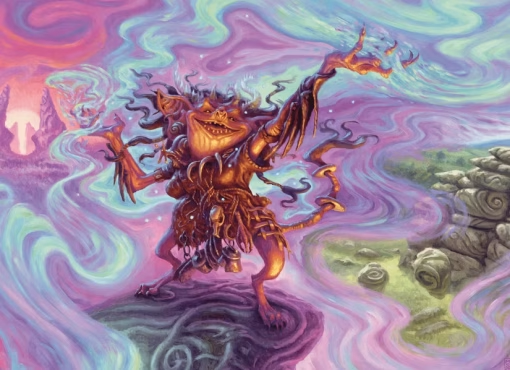
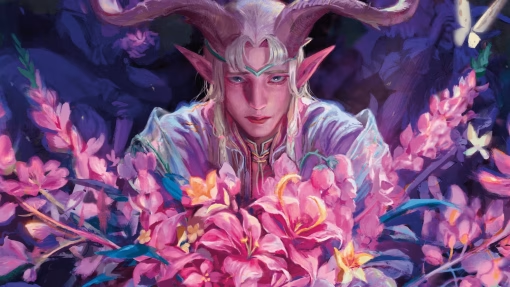
The presentation of Ryoko’s Guide to the Yokai Realms is consistently strong. Top tier artwork communicates the tone and theme clearly, depicting elemental combatants, spirits, and large scale creatures without overwhelming the page.
Layout and organisation of text support the player’s use of the book, even in mechanically dense sections. This makes the book readable as well as functional at the table as a quick reference guide.
Wrath of the Kaiju
Included alongside the main book is Wrath of the Kaiju, a supplemental adventure framework built around an escalating series of kaiju encounters. Rather than presenting a single standalone fight, this supplement is structured as a progression, with each battle increasing in difficulty to scale with a party levelling up.
The encounters are designed to showcase the kaiju mechanics introduced in the core book. Each battle highlights new environmental pressures and evolving objectives that go beyond simply reducing a monster’s hit points to zero. This escalation helps prevent repetition and reinforces the idea that kaiju fights are events rather than standard combat encounters.
Importantly, Wrath of the Kaiju provides a plot with multiple hooks that help you learn how to conquer that kaiju plus and aftermath. Defeating or surviving one kaiju encounter has consequences for the next mini – adventure, whether through lingering environmental damage, resource depletion, or narrative fallout. This makes the sequence feel more like campaign arcs than a series of disconnected boss fights.
The supplement also functions as a practical reference for DMs. By presenting complete encounters that use the kaiju rules as intended, including a flow chart that gives you options on what to do, if the party trigger the next stage successfully and how that changes that party’s battle conditions for the next part of the fight
DMs can insert these battles into an existing campaign, scale them to party level, or use individual encounters as climactic set pieces without committing to the full sequence.
Overall, Wrath of the Kaiju serves as both an adventure supplement and a teaching tool, giving DM’s the kaiju system in a way that feels ready to play even if they don’t grasp it all before hand
Spells

The spell list included in Ryoko’s Guide to the Yokai Realms is, for the most part, a strong addition to the game. A lot of the spells introduce ideas that feel fresh without pushing into obviously broken territory, which is not always an easy balance to strike in 3rd party design and most of these spells feel like options you would be happy to lift into an existing campaign
There are a handful of spells that feel either a bit situational or underwhelming in practice, but they are the exception rather than the rule. There is some quite inventive stuff here rather than just improvements or reskins of existing spells.
That said, a couple of spells do stand out as potentially overpowered, most notably Steelskin and Nomi’s Adamantine Carapace. The issue here appears to stem from how their base AC is intended to interact with Dexterity modifiers and shields. As written, these spells seem to allow Dexterity modifiers and shield bonuses to stack on top of their already high base AC values. Given how base AC works across the Player’s Handbook and various racial traits, this interpretation feels consistent with rules as written, but it creates a problem in play.
Overall, we felt the spell list is well designed, with far more hits than misses. A small amount of table-side interpretation is needed for a couple of cases, but nothing here feels like a big misstep.
Overview
Ryoko’s Guide to the Yokai Realms is an ambitious supplement focused on expanding how D&D 5e handles teamwork, customisation, and especially large-scale encounters. While it introduces a lot of new systems, most are modular and can be adopted gradually and used in any setting.
For DMs and players interested in folklore-inspired fantasy or players looking for more coordinated combat,this book offers a substantial set of tools worth exploring.
Final Verdict – 5/5
A strong addition to the 5e ecosystem, particularly for groups looking to move beyond standard combat and character options while remaining within familiar rules.
Spotlight on the Forgotten Realms
Our latest guides on the Forgotten Realms books.