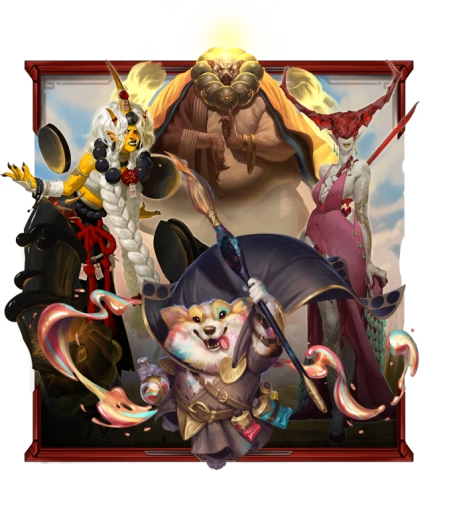
Theres a plethora of new race options in Ryoko’s Guide to the Yokai Realms
There’s a great selection of new race options in Ryoko’s Guide to the Yokai Realms, with some unique traits to get stuck into.
All of them are designed in the 2014 paradigm where each race comes packed with specific stat boosts. These will inform optimal class choices that make the best use of these.
If you choose to use the 2024 style rules with stat allotment based on your background, this will be less of a factor and your chosen class will be much more open as you can craft the statline needed for success.
This guide addresses the classes as they are written in the book, giving advice on the best classes and how to use the traits each race has as optimally as possible
Enkoh: Frost-bound crafters of the mountains
Appearance
The Enkoh are a thick furred ape-like race, adapted to life in the freezing peaks of the Yokai realm. They are divided into two subraces that live harmoniously, Hulking Enkoh (resembling white gorillas) and Springtail Enkoh (closer to a monkey)
Culture
The Enkoh people live in close knit mountain colonies and pride themselves on their crafting ability, specialising in sculpting ice. Whole settlements are crafted from ice, which of course are not permanent. This leads the Enkoh to value relationships over possessions.
Standout Abilities
Hulking Enkoh – Chest Beating is the most interesting ability for the Hulking Enkoh. With a bonus action your character can become resistant to bludgeoning, slashing and piercing damage. This is ideal to activate as you head into battle, it’s useful for any class but is even more beneficial for melee types that should expect to be hit more in the heat of combat.
Springtail Enkoh – For skill focussed builds the Springtail Enkoh adds even more to your character’s repertoire. They have the choice to gain additional proficiencies in 2 of the following skills: acrobatics, animal handing, nature, performance and survival. This is useful for Bards or Rogues relied upon to help the party pass checks.. This is not particularly combat focussed but for Rogue’s or Bard’s who the party rely on for passing skill checks, a Springtail Enkoh can add even more to the impressive array of skills on offer.
Fuyōren: Nimble river spirits that flow across the battlefield

Appearance
The fuyōren are river dwelling plantfolk with graceful, slender frames, adorned with water fauna. They look humanoid in terms of dimensions, but their skin would range in colour across the greens, blues and pale pinks found in water plant life.
Culture
Fuyōren live in secluded settlements nestled in rivers and lakes. Fuyōren personalities are strongly related to the season they are born in. Those rooted in winter might have a frosty temperament while spring fuyōren could be cheery and energetic.
Fuyōren have a deep reverence for kaiju, with some making it a personal quest to promote peace by leading kaiju away from populated areas.
Standout abilities
In the right environment, Graceful Step, can help your character hurry across rivers, quicksand, or mud unhindered. This is going to be most impactful when you can position enemies in these difficult terrains where your fuyōren can move with ease and baddies struggle to maneuver as normal.
With the fluid motion ability, Fuyōren have advantage on saves to avoid being restrained, paralysed, or petrified, these aren’t common conditions but if you find enemies afflicting the party with these conditions, your fuyōren can be bold without worrying about being caught in these.
Recommended Classes
The best class for a Fuyōren are rooted in the stat boosts they naturally receive. With a +2 to dexterity and +1 to wisdom, the Fuyōren are a good fit for nimble dexterity focussed classes like rangers, monks, and rogues. Clerics and druids also benefit from the +1 wisdom bonus to enhance their spellcasting, while the dex boost is handy when calculating AC if using light or medium armour.
Hanamori: Passionate plantfolk who adapt to their surroundings
Appearance
The Hanamori are another plant based race. They look a bit different from fuyōren with skin covered in bark and adorned with pink toned flowers. Hanamori also mirror physical aspects of the land they live in, sometimes this is a permanent change, as their bodies become a kind of record of their life to date.
Culture
Hanamori aren’t as long lived as many races (living to about 60) but rarely waste time overthinking and are known for their passionate nature
Hananori have a special relationship with death, holding dear the cycle of life and decay. They also possess the ability to temporarily absorb the essence of those who perish in their presence, even taking on aspects of their character temporarily.
Standout abilities
The Hanamori’s signature power, Essence Capture is pretty unique among D&D races. When a creature dies within 10 feet of them (and has a CR equal to or lower than your level), you can use a reaction to borrow a fragment of its essence and gaining one of the following until your next long rest;
- Copying one of the creature’s ability scores
- Gaining a special sense like darkvision or tremorsense
- Picking up resistance to a damage type
- Gaining immunity to a condition (like being charmed or stunned)
The most useful here is probably grabbing a resistance if one is available. While results are fun it’s hard to make the best of them as they can’t really be planned for. However if you can anticipate what’s ahead they could be useful. For example, if you know you’re facing a fire-themed dungeon, wait until something nearby with fire immunity dies and grab that resistance. Generally staying close enough to low level bloodied enemies in battle will give you the choice to take something useful.
Recommended Classes
With a +2 to Charisma and +1 to Wisdom, Hanamori are natural fits for classes like Bards, Warlocks, Sorcerers, and Paladins who use charisma as their primary spell casting ability. Clerics and Druids can also make use of the wisdom bonus, but it’s not quite as impactful.
Haniwa: Clay Guardians of Memory
Appearance
Haniwa look roughly like a terracotta statue brought to life, they would be humanoid but the specifics are decided by the statues creator, so a player can specify this.
Culture
Haniwa are clay guardians created long ago as sentinels for the tombs of ancient rulers. While most entered a statue-like state long ago, they have begun to awake with little or no memory of their original purpose. Most of the tombs are lost to time and the Haniwa emerge into a strange new world unmoored from the past. Most become guardians in some form, as paladins or clerics, others even dedicate themselves to uncovering and preserving the past.
Standout Abilities
Clay construct is quite a unique ability, once per long rest your haniwa can create a clay construct companion, with the stat block of a giant weasel, mastiff, mule or hawk. The constructs have some limited combat utility, but offer utility out of combat solving puzzles, creating distractions and even transporting small objects.
Recommended Classes
Haniwa receive a +2 increase to constitution and a +1 to wisdom. Higher constitution is great for any class, as it will increase their HP. However tankier wisdom spell casters can really benefit, as they will use the wisdom bonus for a stronger spell casting ability, while the constitution grants them more health and a stronger chance to maintain concentration checks for ongoing spells. As such, Haniwa make great Clerics, Rangers and Druids (particularly ones that don’t have wild shape as much).
Monks can also see benefit here as one of the more MAD classes, trying to build into dexterity for offence, wisdom for certain abilities (like unarmored defence) and constitution for survivability.
Isetsu – Shelled combatants from the deep
Appearance
Settling along coasts of the Yotai realms, the Isetsu are strong, tough crabfolk divinely appointed to defend the land from the threats of the ocean. They have 4 limbs with claws for hands, and 4 extra vestigial legs that don’t really function in a Mechanical way.
Culture
Itetsu feel an intense draw to journey the ocean waves, but their role as shore sentinels prevents them ever fulfilling this desire, leaving them feeling trapped between two worlds. The further from the ocean they go, the more the Itetsu feel drawn to return.
Isetsu hold the belief that everyone treads a predestined path in life, but that the manipulation of luck is a skill that can be learned. Other races can’t figure out how the Itetsu seem to come up lucky so often, but fortune certainly seems to favour them, more than any other group.
Standout abilities
Isetsu always have luck on their side. They can reroll a missed attack or failed check an amount of times equal to half their proficiency bonus rounded down. Obviously there’s a finite number of times this can be used, so don’t use it on potshots, save them for a big spells that use higher level spell slots to or pivotal attacks to ensure they stick.
After any kind of rest Isetsu also receive a +2 bonus to AC until they first receive a hit. This Brittle Armor incentivises the player to do as much as they can to preserve the bonus by remaining in cover, or as a spell caster stacking the bonus with shield or shield of faith to evade attacks for as long as possible.
Recommended classes
Isetsu have some interesting racial features, but they don’t necessarily all benefit the same types of classes.
Isetsu’s natural armor gives an unarmoured character AC of 12+ their constitution modifier. This is ideal for squishy mages, who can’t wear armor without compromising their spell casting.
The isetsu’s natural stat boost are +2 strength and +1 constitution. The stats do not favour a spell caster though, but are ideal for barbarians and fighters who need strength for hitting melee attacks and extra constitution to contribute to more health.
The Isetsu are a bit of a funny class with something to offer either a melee or a spell casting class, but without really specialising and giving too much to either. However, you stand to gain something from this race choice, whichever build you choose.
Kitsune – Sly foxes with an appetite for adventure
Appearance
Kitsune are fox-like humanoids most distinguished by their furry pointed ears and multiple flowing tails, one for each century they have lived, up to nine.
These tails are not just decorative, they are an essential part of their complex, nonverbal language. Through subtle movements like kitsune communicate nuance, and meaning beyond what verbal language can offer.
Culture
Kitsune can live up to 1000 years but never lose a sense of curiosity. The ancient kitsune are respected across the Yotai realms as scholars, diplomats and merchants.
Many wander the breadth of the realms seeking to understand the world through life experience, and they have plenty to spare. They are happy to share what they have learned and love to regale willing audiences with stories and songs of their findings.
Standout Abilities
Ascendant Form allows your Kitsune to radiate bright light for 10ft (plus 10ft of dim light) for up to 1 hour. Friendly creatures in the light can add 1d4 to their Intimidation, Perception, and Persuasion ability checks. Also, when a creature within 10
feet of you misses an attack roll or fails a saving throw, you can use your reaction to add 1d4 to the result. This part of the ability can only be used once on each friendly character, until the next time Ascendant form is activated.
The real value comes from the reaction-based 1d4 boost to failed rolls. Use this to turn close misses and hits or to help allies succeed on saving throws against negative status effects
Ascendant Form is also useful outside combat, adding 1d4 to allies’ intimidation, perception, and persuasion checks (you can’t do all the social work yourself after all). Be wary NPCs will be able to see the Kitsune is affecting the results, so consider this if you are trying to be sneaky.
Kitsune spellcasters should also rely on their shapeshifting and transform into a fox to slip through tight spaces, avoid grapples, or distract enemies. In this form Kitsune can still cast spells with only a verbal component, speak and maintain concentration in fox form, so if you took a casting class you don’t lose much by shifting into a fox in a pinch.
Recommended Class
The kitsune’s racial traits work best for classes that rely on charisma, making them excellent sorcerers, warlocks, and bards. Their natural +2 to Charisma and +1 to Dexterity enhances their spellcasting and increases their AC a little bit.
Ascendant form fits well with the support role the Bard normally offers and The Kitsune’s Guile offers a choice of proficiency in deception, persuasion or stealth, adding more to the bards swiss army knife of skills.
Oniborne – Monsterous adventurers full of passion
Appearance
Onibourne possess coloured skin, horns, yellow eyes and prominent lower jaw fangs. The skin colour can vary between green, red and blue and their wild hair can be black or white.
Culture
Oniborne are descended from the menacing Yokai called Oni. Whether they are virtuous or villainous, all Oniborn are distrusted or even feared because of stories of the menacing Oni. Oniborne are also known for their passionate nature, prone to bursts of emotion, that in younger Oniborne can even lead to uncontrolled bursts of magical power.
Oniborne’s passion often finds an outlet in the life of an adventurer. Many Oniborne become soldiers of fortune or mercenaries, uncomfortable with settling down in a routine life.
Standout Abilities
Red Oniborne: In a cultural rite of passage Red Oniborne who come of age venture alone to slay the mightiest beast they can find. From that beast they harvest a weapon as part of their Magical Scavenger ability. The weapon becomes any melee or thrown weapon with a +1 bonus to attack and damage rolls. This bonus increases to +2 at 9th level and +3 at 17th level.
This is most impactful at low levels, where you will have a leg up on the rest of the party’s standard equipment. It could be outscaled later as the DM grants better options through the story, but when those weapons come along you can always switch to that.
Blue Oniborne: Compassionate Heart is ideal for team players, your Oniborne can take the Help action as a bonus action a number of times equal to your proficiency bonus, regaining all expended uses after a long rest.
The icing on the cake is when you take the Help action, you can expend one of your hit dice to grant an ally temporary hit points equal to one roll of that die plus your Constitution modifier (minimum 1).
Ideally stay close to a Barbarian or Fighter, as they will hit the hardest. Of course, you will be using your bonus action, so consider what spells of abilities this will be used instead of.
Green Onibourne: Ghastly Visage allows your Oniborne to use a bonus action after attacking to try and magically frighten an enemy within 5 feet. That creature must make a Wisdom saving throw or be frightened for 1 minute. This is a great way to thin out a big group of enemies, focussing attacks on one, while frightening off another to avoid getting boxed in.
Usable a number of times equal to the characters proficiency bonus, I would not advise holding them back, unless you anticipate many more fights. It’s a great way to ruin enemy formation. If they fail the check, and run away the fight is much easier from there.
Recommended classes
All Oniborne receive a Constitution bonus of +1. Most classes can make good use of this for more health or maintaining spell concentration. Red Blue and Green Onbourne receive +1 bonuses to Wisdom, Strength and Charisma respectively.
Red Oniborne harvest their own weapon and feel most at home as melee fighters, but the wisdom and constitution bonuses suggest they may be best as a Cleric, durable in the thick of it and able to strike back when needed. Ranger might also be well suited, they can be built as melee combatant and use Wisdom as a spell casting stat.
While Blue Onibourne receives a Strength boost and their main ability allows them to use the Help action as a bonus. So a good fit here is a Fighter or Barbarian, who can use more strength and often don’t make use of their bonus action.
Green Onbourne seem like they would be great Warlocks,Sorcerers or Paladins using Charisma for spell casting and the Ghastly Visage to aid a close combat plan if they are tangled up with melee based foes.
Ryokido – Cat turtles with long lives and longer memories
Appearance
Ryokido are an interesting mix of reptile features. Colloquelly known as ‘Lion Turtles’, they have squat, cat-like faces, but scaled skin and a massive shell. Each shell is different to any other Ryokido’s, acting as a unique identifier for them
Culture
Ryokido are very long lived, with lifespans reaching up to 600 years, this long life experience is enriched by their telepathic abilities, helping them become highly empathetic beings, who are responsive to the feelings of those around them. Memories are valuable to the Ryokido and can be passed on to their village shaman to preserve the collective wisdom gained across a lifetime.
Standout Abilities
Telepathic Bond is a flexible ability that allows a Ryokido to form a telepathic bond with a willing creature they can see within 100 feet of you. For 1 hour they can communicate with the chosen creature telepathically.
This is useful if your group is set to split up or send a member off scouting. It could also come in handy for situations where stealth is important or in social situations where the party cannot confer but need to share ideas.
Recommended Classes
Ryokido are quite open ended, their abilities don’t hint toward an ideal class, and they naturally receive +1 stat bonuses to Strength, Wisdom and Charisma.
The Tough Shell ability is similar to that of Tortle’s, a natural AC of 12+ Constitution Modifier. This is a neat way to protect a spell caster who can’t wear light armor. To make the most of this and the bonus to Charisma, a Ryokido might fit well as a Wizard or Sorcerer
Tatsumi – Fishfolk with draconic potential
Appearance
Tatsumi is a collective term, but refers to two sub-races; Nishikin and Ryūjin.
- Nishikin – Tatsumi starts life in Nishikin form, with the dimensions of a humanoid, but with some features of a koi carp. Noseless faces with big eyes, a finned tail and shimmering scaled skin are the main identifiers. Each Tatsumi is born with its own unique colouration. In Tatsumi culture one’s primary colouration holds special significance.
- Ryūjin – While Tatsumi begin life as Nishikin, a significant moment in their life could trigger the transformation to Ryūjin form. All semblances of the koi are replaced with the features of a majestic dragonfolk, their primary colour being the only identifier that remains. Tall and powerfully built Ryūjin look like an eastern influenced version of Dragonborn in the forgotten realms, complete with a long, slender tail and face with an extended snout and barbels lining their face.
Culture
Tatsumi live in settlements based in lowland lakes, where both the Nishikin and Ryūjin work in harmony to create an industrious society. Nishikin are full of energy, working tirelessly, eager to do their best at their chosen task. In moments of great passion a slumbering dragon may manifest itself to provide guidance or advice to a worthy Nishikon in need.
Not every Nishikin will experience transformation to Ryūjin form. Those that do often mark this change by also altering their course in life, taking on a new role or even leaving their village to adventure on the road. Ryūjin are known for being more laid back then their Nishikin relatives, as if the transformation also triggers a change in perspective, granting a new sense of careful patience.
Standout Abilities
All Tatsumi have a colour most prominent in their scales, this affects their abilities in both Nishikin and Ryujin form. Each colour corresponds to an ability score for Nishikin and a class for the Ryūjin, which then keys off a trait for each of them respectively:
Nishikin – Slumbering Dragon: When a Nishikin makes an attack roll, ability check, or saving throw using the ability associated with their primary colour, they can use a reaction to add 1d6 to the roll. This ability is quite simple, working a bit like bardic inspiration and its real value is how flexible it is. The character even regains uses on either a short or long rest.
As long as you choose the colour that corresponds to the key ability score of your class, it will almost always be useful. This kind of ability is replenished easily and as your character’s proficiency score increases, you can feel free to apply it early and often, knowing you can rest to get those uses back.
Ryūjin – Innate Magic: Almost as flexible is Innate Magic. You can learn one cantrip of your choice from the spell list of the class linked to your primary scale colour.
This allows for some fun combinations, with classes able to gain the use of a cantrip normally locked to certain spellcasters. For instance, taking Black as the primary colour would allow you to borrow Eldritch Blast from the Warlock list, a welcome addition to a sorcerer or bard. Paladins and Monks could also benefit from adding this spell to their repertoire.
Recommended Classes
Tatsumi receive innate stat boosts to Dexterity, Wisdom and Constitution. The latter two would be useful for a Ranger, as one increases their spell casting ability and other how long they can stay in the fight.
Alternatively the Nishikin ability Slumbering Dragon favours classes with lots of important skill checks to make, especially rogues as they cover checks like stealth or sleight of hand for the party. Rogues also do not get a lot of chances to attack each round, instead placing all of their eggs in a single sneak attack, which Slumbering Dragon can help to succeed.
Heartening Breath from the Ryūjin form offers allies a 1d4 boost to attack, ability check or saving throws for up to a minute, adding even more battlefield support options on top of the healing a cleric normally offers.
Tengu – Mischevious forest guardians
Appearance
Another race that is heavily linked to familiar depictions of Japanese folklore, Tengu are split into two subraces. The Hanataka Tengu will be more familiar and have bright red skin, glowing yellow eyes and long prominent noses.
The Karasu Tengu possess some avian qualities, like a beak and vestigial feathery wings, but have the same lithe agile build.
Culture
Tengu are long-lived forest dwelling Yokai, most are territorial and reclusive, but some younger Tengu possess an adventurous spirit that leads them to wander the wider world.
Despite their predilection to mischief Tengu take their duty as forest protectors seriously and prize highly the rituals of their culture. Weddings, funerals and other rites are steeped in reverence and tradition.
Standout abilities
Hanataka – After you take the Attack action Hanataka Tengu can use a bonus action
to cast a cantrip or make a number of melee attacks equal to half your proficiency
bonus. This is a powerful ability that allows you to be effective in a horde, but also puts the character at risk, so is best used by melee combatants like Fighters or Barbarians.
The Whirlwind Onslaught ability is only usable once per long rest, so choose when to activate it wisely. If there is any way in the party to help those attacks land like bardic inspiration, it’s a great time to use them.
Karasu – Psychic Battery gives you the ability to trade an attack for a psychic assault against a creature you can see within
15 feet. That creature must succeed on a Wisdom saving throw or suffer the effects of the Confusion spell until the end of its next turn. This is also usable once per long rest.
While Whirlwind Onslaught is best utilised against a group of foes, this Psychic Onslaught debilitates a single foe if successful causing them to take a random action on their turn that is generally detrimental to them, until they can succeed on a Wisdom saving throw.