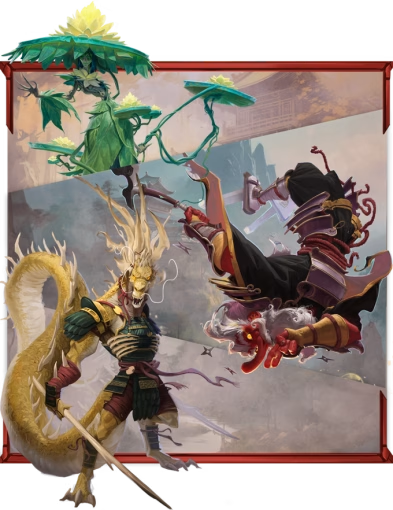
Transform into a hag-like being with this fey lineage that likes to trick and curse.
Some beings have their very nature transformed by some magic or event. It transforms them into something not quite like their original race. These are known as lineages and are a special subset of races found in Van Richten’s Guide to Ravenloft.
One of these lineages is the Hexblood. These are those transformed by Fey powers, especially those possessed by hags and witches. Normally, a Hexblood is born of a Fey bargain of some kind that leaves an indelible transformation on the bargainer or those they bargain for. These effects may not be immediate. Sometimes they form over time or are transferred to an offspring. Either way, the recipient of these changes develops hag-like features; discoloured skin, ears that split into points and long hair that regrows if cut.
Along with this come powers that can charm and beguile the senses as well as those that can hide from the senses of others.
If you want to play a Hexblood, then read on for advice on optimisation and tactics.
Is a Hexblood the right species for me?
Choose a Hexblood if you want to…
- Have the hex spell
- Spy on people
- Use innate spellcasting
A Hexblood might not be for you if…
- You don’t want innate spellcasting
- Lack the attacks to benefit much from hex
- Aren’t playing a cunning or deceptive character
Using a lineage
Lineages are a little different from standard races. They transform a character from their original race into something a fair bit different, though they also retain attributes of their original race.
If you’re creating a character that starts with a lineage, then this just replaces the traits your race would have given you. However, if you start as another race and then gain a lineage during the game, you do the following:
- Replace all your original racial traits with the traits from the new lineage.
- The exception is for the traits specified in the ancestral legacy trait of your new lineage. This states that you can retain any skill proficiencies from your original race and/or any climbing, flying or swimming speed you gained from your original race.
- If you choose not to keep these skill proficiencies and extra movement types, then you can instead choose any 2 skill proficiencies to gain instead.
And that’s it, you now have your lineage.
Hexblood traits
| Ability score increase | Increase 1 ability score by 2 and another by 1 or increase 3 ability scores by 1 |
| Languages | Common and 1 other |
| Creature Type | Fey |
| Size | Small or medium |
| Speed | 30ft |
| Traits | Ancestral legacy, darkvision, eerie token, hex magic |
| Resistances | None |
| Proficiencies | Those from your race or 2 of your choice |
| Darkvision | Yes |
| Innate spellcasting | Disguise self, hex |
| Book found in | Van Richten’s Guide to Ravenloft |
Tactics

Hexbloods combine some amounts of subtle utility with spellcasting (specifically the hex and disguise self spells). If you don’t think you can get much from hex or a bit of sneakiness, then you may struggle with a Hexblood.
Hex in name, hex in nature: Hex is a strong 1st level spell, especially for those making plenty of attacks. It’ll increase the damage of each attack against a target impacted by this and only requires a bonus action to apply. This makes it great for high attack classes like fighters. You’ll only get one use per long rest (unless you’re already a caster) so time your uses carefully for tougher encounters. Just be aware that it does have a bonus action cost whenever it moves target so monks will have to balance that with things like flurry of blows, as will other bonus action reliant classes.
Long range telepathy: Telepathic message is a very long range form of telepathy. Much longer than most telepathic options. It does have its drawbacks like one way communication, and you will need to predetermine your target, but split parties and coordinating with NPCs can become easier this way.
Super spy: Remote viewing is a great way to spy on others if you can determine their location in advance. It might even be that you can chuck it discreetly near someone you want to eavesdrop on without needing to get as close to them. If you do this, a tooth probably makes your best projectile, even if it’s one of your more grotesque options.
You’ve also got disguise self in your repertoire which is great for impersonations and sneaking into places you shouldn’t be. You may want a decent charisma if you intend to go around making such deceptions.
Choosing a class for your Hexblood

Below I’ve scored how well each class works with a Hexblood:
Artificer⭐⭐⭐
Barbarian ⭐
Bard ⭐⭐
Cleric ⭐⭐
Druid ⭐⭐
Fighter ⭐⭐⭐⭐⭐
Monk ⭐⭐⭐
Paladin ⭐⭐⭐⭐
Ranger ⭐⭐⭐⭐
Rogue ⭐⭐
Sorcerer ⭐⭐
Warlock ⭐⭐⭐⭐⭐
Wizard ⭐⭐
*Star ratings scored out of 5
Best classes for a Hexblood
The main thing to keep in mind with a Hexblood is their hexing capabilities. Everything else is more situational. Hex doesn’t require a good spellcasting ability making this irrelevant, but casters can repeat cast the spell. Disguise self can rely on your spellcasting ability if being inspected though.
I’d also suggest that Hexbloods slightly lean heavier into high charisma classes due to their need to deceive from time to time. But their hex capabilities remain the most important aspect of the lineage.
Because of this, I’d suggest that the best classes for a Hexblood are:
In each of these cases, the class has multiple attacks which suits hex well. Warlocks can get this either through eldritch blast or the thirsting blade eldritch invocation.
In fact, despite getting hex through their spell list, warlocks are one of your best options for a Hexblood. This is partly because this is a free spell slot, which you likely don’t want to use on hex once your spell slots can be used for higher spell levels. It’s also because warlocks happen to be a charisma class.
A paladin needs to be careful of the conflict with smite spells, bonus action and concentration. If you need to be more efficient with spell slots and go less for nova damage (or stick to divine smite) then hex can be a good option. Paladins also happen to be a charisma class.
Fighters are bonus action-lite, but also have lots of attacks making hex one of the best options for them. Rangers can use hex as a hunter’s mark alternative, saving a spell slot each long rest.
Worst Hexblood classes
Hexbloods rely a fair bit on spellcasting and barbarians not only can’t do this while they rage, but they also struggle for a decent spellcasting ability score. This makes them the worst option here.
Most dedicated spellcasters will struggle here too. Partly because they make too few attacks to make good use of hex, but in some cases, because their bonus action is under high demand, as is the case for bards.
Rogues struggle with the Hexblood’s traits too. With just a single attack and a heavily utilised bonus action, they lack the flexibility for hex.
About Hexbloods
Appearance

Hexbloods retain the appearance of their former race, but they develop hag-like features. This can include discoloured skin, split ears that form a point, hair that regrows when cut and an irremovable living crown.
You can flavour your appearance to be more or less hag-like depending on how you want your character to appear.
How can you become a Hexblood?
Hexbloods can be formed in many ways, but they usually are created from the magic of a hag or similar fey creature. There are a few ways suggested that you could become a Hexblood, but you could also come up with your own:
- You are the child of a parent that made a bargain with a hag to gain a child.
- Fey kidnappers swapped you and your parent’s child.
- You were created to replace a hag lost from a coven.
- Cursed as a child, you became free of the curse by making a deal with the spirits that also transformed you into a Hexblood.
- You began life as a fey, but an accident caused you to flee home and become a Hexblood.
- A slighted druid transformed you and bound your life to the life of a sacred tree.
- You made your own bargain with a hag, becoming a Hexblood as a result.
How to roleplay a Hexblood
Becoming a Hexblood often isn’t something that characters want or seek. In many cases, it’s unexpected. Many characters may choose to hide their appearance or work to have their appearance changed. Your character may attempt to hide their appearance or feel awkward when it’s mentioned. They may also seek to reverse the effects of their transformation.
Alternatively, they could lean more heavily into their hag heritage. They might become a little more deceptive and embrace trickery, using those gifts they’ve been granted. This might especially be the case if your character was born a Hexblood.
You may also want to think about how you enact some of the more grotesque elements of your traits. Removing a tooth or fingernail for eerie token is pretty gross. Do you embrace that, or do you turn around and hide while you perform the act?
Other D&D race guides
Not sure a Hexblood is the right race for you? Why not check out one of our other race guides for D&D 5e.